
RN-To-BSN Program CCNE Accredited
Degree Advancement Program for Registered Nurses
Admission Requirements: RN to BSN Program
Applicants seeking admission to the RN to BSN Completion Program must meet all institutional admissions requirements and all program-specific requirements. Admission is competitive and is contingent upon completion of required documentation, official review of transfer credit, and satisfaction of institutional policies.
Applicants must meet the following minimum requirements:
• Be at least 18 years of age.
• Possess a regular high school diploma or recognized equivalent received prior to the first day of attendance.
• Hold a current, active, and unencumbered Registered Nurse license in the United States.
• Provide evidence of completion of an associate degree in nursing or another qualifying prelicensure nursing credential accepted by the institution.
• Submit official transcripts from all post-secondary institutions attended.
• Meet English language, technology, and other institutional requirements published in the catalog and enrollment documents.
• Be in good academic and professional standing and otherwise eligible for admission under institutional policy.
Submission of an application does not guarantee admission. Admission does not guarantee that all prior credit will be accepted or applied toward the BSN degree requirements.
Foreign Credential Evaluation
Applicants presenting education completed outside the United States must provide an official foreign credential equivalency evaluation from an institutionally approved evaluation service, or such evaluation must be conducted and accepted by the institution before transfer credit will be awarded. The evaluation must identify U.S. equivalency, and when required by the institution, include degree equivalency, course-by-course analysis, and credit hour equivalency.
Transfer Credit Policy: RN to BSN Program
The institution may accept up to 72 semester credit hours in transfer toward the RN to BSN Completion Program. Transfer credit will be considered only for coursework documented on official transcripts from institutions accredited and recognized in the United States by an accrediting agency approved by the U.S. Department of Education or otherwise accepted under institutional policy.
Transfer credit is evaluated for applicability to the BSN degree requirements. Coursework must be appropriate in level, rigor, content, and degree relevance. Transfer credit may be applied to general education, nursing concentration, and total degree hours when applicable and approved through the institutional transfer evaluation process.
A student's acceptance into the program does not by itself establish that all transfer coursework will apply to graduation requirements. Transfer credit is awarded at the discretion of the institution.
Program Length
The curriculum consists of a total of 120 credit hours. The average length of time for a student taking a full course load is 4 semesters (12-16 months) when transferring in all applicable nursing degree, general education credits, and required pre-requisites.
The content of the 120 credit hours required for graduation including the transferred credits in nursing and non- nursing courses is shown here. The applicant can transfer up to 72 credit hours:
| 1. All nursing associate degree or diploma |
30 credits |
| 2. All general education courses |
30 credits |
| 3. Non-nursing elective courses |
12 credits |
|
Total |
72 credits |
* Selected courses: Cultural Diversity, Health Promotion, and Case Management.
Requires General Education Courses
Students enrolled in the RN to BSN completion program must transfer in 30 general education credits. All general education courses must be completed with a grade of "C" or better with an overall GPA of 2.5 or better in order to be accepted for admission and to graduate. The 30 transfer credits are distributed among the following disciplines:
| 1. Communication Skills: Speech, English Composition, Literature |
6-12 credits |
| 2. Social or Behavioral Sciences: Sociology, Psychology, Ethics |
6 credits |
| 3. Mathematics: Algebra, College Algebra, Statistics |
6 credits |
| 4. Technology Applications Courses: Microsoft, Spreadsheet, etc. |
3 credits |
| 5. Natural Sciences: A&P, G&D, Environmental Sciences, Microbiology |
6-8 credits |
| 6. Humanistic: Philosophy, World History, Critical Thinking* |
3-4 credits |
| 7. Global Awareness: Geography, Religion, Nutrition, Business |
4 credits |
| 8. Electives: Cultural Diversity, Physical Education, Chemistry |
3-4 credits |
| Total (Minimum required is 30 credits) |
37-47 credits |
* Transfer of Critical Thinking course will be accepted but it will be repeated to ensure that the graduate understands critical thinking from a praxis perspective.
Allocation of Program 120 Credit Hours
|
Areas |
Courses |
Credits Hours |
| Automatically granted | Nursing courses from associate degree or diploma in nursing |
30 |
| General education | Transferred in or taken from other colleges or universities |
30 |
| Required courses | Current Curriculum Plan -includes 6 units of upper-level G.E courses |
48 |
| Electives | Transferred in -Pathophysiology -Legal or Ethical Issues in Nursing -Nursing Informatics -Statistics -Others (additional general education maybe accepted) |
12 |
|
Total |
120 |
Course Descriptions & Objectives
To view Course Descriptions & Objectives click the Course Title
- N 350 Conversational Public Speaking
- N 355 Advanced Creative Writing
- N 360 Perspectives in American History
- N 365 Healthy Living
- N 370 Concepts of Scholarly Writing
- N 375 Cultural Diversity
- N 380 Health Promotion Across Lifespan
- N 385 Praxis and Theory Transition
- N 390 Concept of Critical Thinking
- N 395 Community and Global Health
- N 400 Evidenced Based Practice Research
- N 405 Concepts of Case Management
- N 410 Community Practicum
- N 415 Current Trends in Healthcare
- N 420 Leadership and Management
- N 425 Nursing Praxis Capstone
Degree Granting Program for Registered Nursing
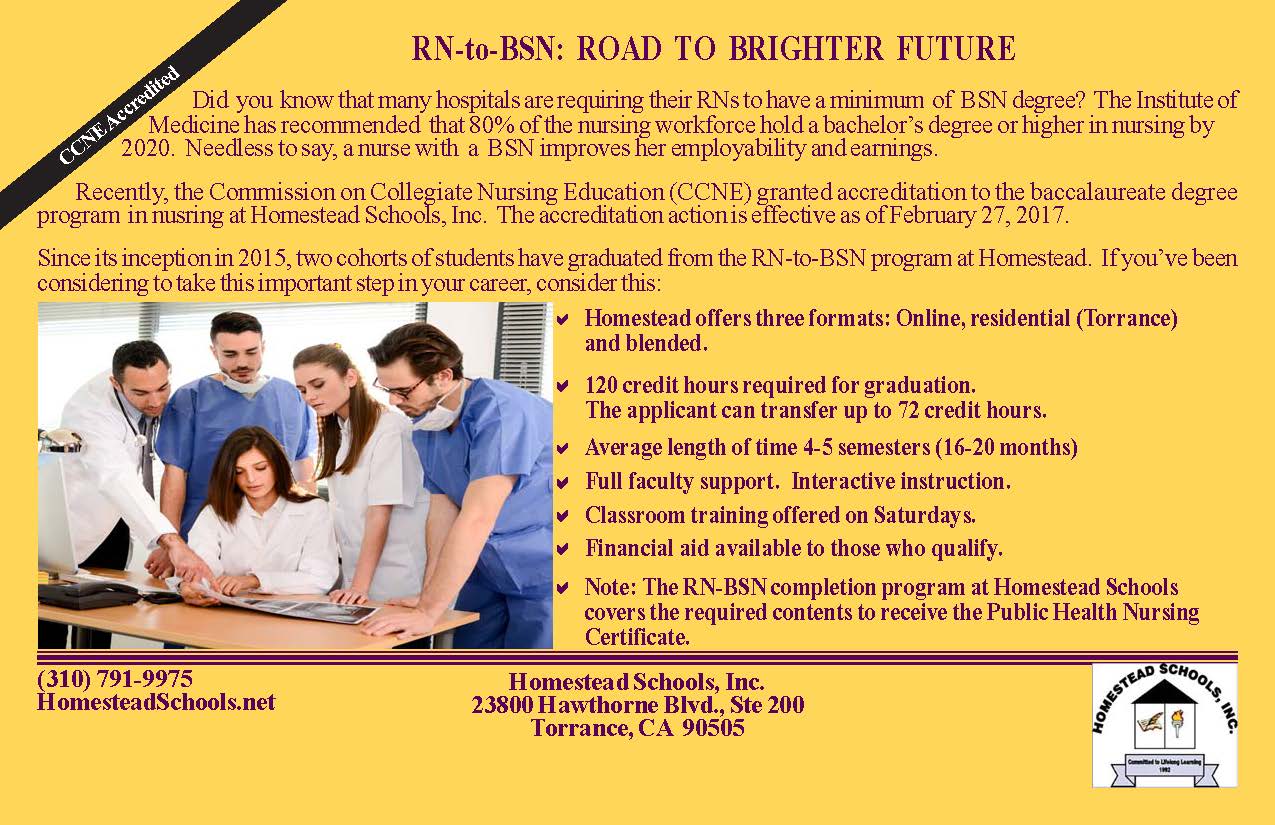
The Institute of Medicine (IOM) has recommended that healthcare organizations increase their bachelor's prepared RN staff to 80% by 2020*. It is also a documented fact that RNs with BSN commit far fewer medical errors than RNs with no advance degree. Precisely for this reason many hospitals, especially those designated "magnet" hire only the RNs with BSN degree. Needless to say, with a BSN you'll improve your employability and earnings. You'll be able to take your rightful place in the healthcare field while providing the highest level of care to your patients.
* Institute of Medicine (2010). The future of Nursing: Leading change, Advancing Health. Washington, DC: National Academics Press.
The Registered Nurse to Bachelor of Science in Nursing (RN-to-BSN) completion program is designed to be taught in five semesters provided that students transfer in required credits. The program is open to licensed registered nurses (RN) who have completed their associate degree in nursing or a diploma in nursing from a nationally or regionally accredited nursing program. The goal of the program is to graduate nurses that will be ready to advance their educational career and that can understand the concept of holistic praxis, think critically, and serve as change agents or leaders in any healthcare and nursing environment.
Mission
The mission of the RN to BSN program is “ to prepare quality praxis-driven professional nurses that can function with strong critical thinking and leadership skills as providers of care, designers-managers-coordinators of care and members of a profession.” The above statement supports Homestead Mission: “to develop men and women imbued with necessary academic excellence, skills, and virtues to address the health care needs of individuals, families, groups, and community.”
Philosophy & Goal
The nursing program’s vision is to prepare quality professional nurses who can think critically from a praxis perspective to promote equity and quality health care. The goal of the program is to graduate nurses that will be ready to advance their educational career and that can understand the concept of holistic praxis, think critically, and serve as change agents or leaders in any health care and nursing environment.
Tracks for degree completion for the RN-BSN program:
- Residential: Offered face-to-face on campus in Torrance
- Blended: Mixture of online and residential courses as elected by the student. The same courses will be offered both online and on campus.
Upon graduation from the RN-BSN completion program, the graduate will be able to:
- Integrate critical thinking skills and theoretical concepts from nursing and other disciplines in clinical or leadership decision making.
- Synthesize evidenced based practice and research in providing holistic nursing care to individual, families, groups, and communities.
- Incorporate a holistic, caring, culturally appropriate nursing approach that contributes to the wellness and the health of individuals, groups, and vulnerable populations.
- Utilize technology and information resources to communicate effectively with diverse patient's population and other health care multidisciplinary team.
- Demonstrate knowledge and skills in leadership and management concepts in the management of care at the local, state, national, and global levels.
- Applies concepts of professionalism and leadership in designing, implementing, coordinating, and evaluating nursing care from a health promotion and disease prevention approach at various levels of population care.
- Provide safe, high quality, culturally competent, patient-centered nursing care for individuals across the health-illness continuum and across life span in a variety of settings.
- Develop a praxis change project (teaching or policy) to assist individuals or communities achieve their holistic health promotion goal.
- Conduct comprehensive and focused assessments of health and illness parameters in individuals, groups, and vulnerable populations.
- Communicate effectively with all members of the healthcare team, including interdepartmental and interdisciplinary collaboration for quality outcomes.
- Assume accountability for one's own and delegated nursing care.
- Engage in continuous professional development
Admission Requirements "Only California residents are admitted to the online nursing program"
- Current and active RN license to practice nursing.
- Possess an associate degree in nursing or a diploma in nursing.
- Minimum of 2.5 GPA on a 4.0 scale in their Associate Degree in nursing or their Diploma. International students' transcripts must be evaluated with United States equivalent and may be required to take an additional English writing course.
- Complete the required online orientation before enrolling in the first nursing course if enrolled as an online students.
- All students must complete the program orientation module prior to beginning the program.
- Show proof of legal residence in the United States.
- Possess a valid Social Security card.
For the RN-BSN program, an applicant may transfer in or possess 36 hours of general education credit from a nationally or regionally accredited college or university. Twelve of the general education credit hours must be at the upper level (300-400 level courses). You can obtain any missing general education credits at Homestead. We offer courses in oral communication, advanced public speaking, report writing, history of the United States, culture and diversity, etc.
Prospective students interested in enrolling in the RN-BSN program are encouraged to contact the admissions office at Homestead Schools (310) 791-9975. We'll help you evaluate your transcripts and determine the number of credits that can be transferred.
Yes. Our RN-to-BSN program is accredited by Accrediting Bureau of Health Education Schools (ABHES), a national accrediting body that has approved all our educational programs.
The RN-BSN program at Homestead Schools, Inc. is accredited by the Commission on Collegiate Nursing Education (CCNE), 655 K Street, NW, Suite 750, Washington, DC 20001, 202-887-6791, www.ccneaccreditation.org
No. This is a post-licensure program which means that the admitted person already has an RN degree. The Board of Registered Nursing does not approve post-licensure programs.
The tuition is dependent on the number of credits you're able to transfer for applicable nursing degree, general education credits, and required prerequisites. Our admissions counselor will be able to evaluate your transcripts and tell you the exact tuition for the program.
Yes. We offer federal student aid to those who qualify.
You should call the admissions office at (310) 791-9975. Better yet, visit the school at 23800 Hawthorne Blvd., Torrance, CA 90505. HomesteadSchools.net